Posts

Emulasim of a Neuron

Image
    J ust when you need it, I created a new acronym = Emulasim. I define it as not a true emulation but a step up from a simulation like halfway between simulate and emulate. I believe AGI falls somewhere in this category. From my own experiments, I emulate the connectome from given datasets and do a halfway job of emulating the neuron. So today I want to discuss Neuron emulasim. In my C elegans experiments and other lower forms like Ciona, I used a simple model of the neuron. The attributes are: The artificial neuron accumulates weights where weights are defined as the number of synapses and gap junctions that are connected between the presynaptic and postsynaptic neurons; e.g. if Neuron A has 3 synaptic connections to Neuron B, when A fires, it sends a message to B of a weight of 3. A specified threshold must be met within a specified time frame in order for the neuron to fire. If the threshold is not met in a specified time frame (e.g. 200ms) then the neuron hyperpolarizes ...

Creating Emulations of Nervous Systems

Image
    L et me begin this post by stating that what is contained within is a simplified idea of the actual coding and there are specifics I am leaving out due to the amount of information would be better contained in a book rather than a blog post. Here I am attempting to highlight concepts and not discuss in detail. Maybe later discussions will allow me to do so?  The key with emulations of nervous systems is real time emulation if you are wanting real life AGI The first order of emulation is machine constraint. When I first did connectomic experiments, pretty much every machine I worked with could only support 250 processes running at a given time (16-bit). I had lunch with a colleague one day in 2013 complaining about this limitation when he asked, "Don't you have a 32 bit system now?". I did so he told me that he bet I could have many more processes running under that architecture. When I got home, I created a quick app that started up 302 notepad.exe and there wer...

AGI Starts with the Stomach

Image
     I feel bad that I didn't write down the scientist that said "AGI must start with the stomach" but he is so right. 99% of AI (ANN/GOFAI/DL/Neurosymbolic/ et al) starts with sensory input and 99.99% attaches the AI to motor activity if it has something to do with robotics, where that motor activity is a direct result of everything sensory. In current AI, motor activity is always secondary to sensory input and most often, AI doesn't even put motor activity as a requisite.  Let me flip the script and instead of starting with sensory input, let me start with motor activity. The reason AGI starts with the stomach is because when we are hungry, we need to move. As an infant, we begin sucking on anything that represents a nipple. As we get older, we grab anything that we know we can eat and put it in our mouths. Even older, we go to the kitchen and make us something to eat. The drive to squash the hunger pain is the reason we learn. To eat in any instance, requires us ...

Recurrence

Image
One of the surprising revelations that I discovered while preforming emulations of animal connectomes is the huge amount of recurrence. The brain literally folds back on itself over and over again.  To illustrate this idea, let's look at C elegans again. Keep in mind that we are working with 302 neurons. Neurons connect to a set of other neurons. This connected set has a number of axons that link back to the originating neuron. If we look at the Interneuron AVAL, AVAL connects to 77 other neurons. These 77 neurons connect to another set of neurons, so on and so on. Each neuron can have multiple connections to other neurons. For example, AVAL has 11 synaptic connections to the neuron DA6. From the first set of neurons that AVAL connects too, there are 83 total synaptic and gap junction connections from those 77 neurons back to AVAL. If we take those 77 neurons and follow what neurons they connect too, we find from that second set (Layer 2), there are 573 neuronal connections back to...

Artificial Connectomes

Image
  From the movie Young Frankenstein                 "Abbey Normal" is of course the perfect scenario of what we do not want to do. To illustrate further, I would start the C elegans emulation and let the robot wander around the house, sometimes for an hour or so. Just let it go. I liken it much like a Cat in that it would explore and do its own thing. One day my wife started calling it and the robot stated to come towards her. To her, calling it made it come to her but to me, I knew what was really happening in that she was activating the sound sensor which in turn was stimulating the food sensory neurons so the robot thought she was food. Not sure this would be the desired effects we would want to occur. Other animal connectomes will most likely give us a number of undesired effects. The obvious consequence to connectomic emulation in the movies around Frankenstein is that if we use a criminal brain, we end up with a criminal. To understand...

Details of the C elgans Neurorobotics Experiment

Image
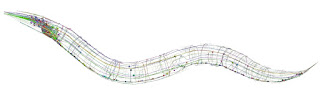
Caenorhabditis elegans (C elegans) Hermaphrodite Wild Type has a fully mapped connectome of 302 Neurons. C elegans is the most studied animal on earth. The connections and connection types (Chemical and Electrical), and the function of each neuron is well known (Sensory, Interneuron and Motor Neurons) Nervous systems are messy, noisy systems, each neuron works independently of one another, and I wanted to recreate that system as close as possible. We have this vision that neurons are nice, neat tubes but in reality, they are like a play-doh snake someone has smashed and squished. I created a single program that can assume the identity of each of the 302 neurons that make up the C elegans connectome. Each of the 302 individual programs message to the other programs via User Datagram Protocol (UDP). UDP is like TCP but doesn’t care about packet loss. UDP is how most video and audio is transmitted over the internet.  To simulate connections, I used the number of connections as a weigh...

What is Connectomic AI?

Image
What is Connectomic AI?   I define Connectomic AI as an Artificial Intelligent system based on connectomic/synaptic modeling. This can be created using actual connectomic maps or using the essence of connectomics. Unfortunately, complete connectomic maps are very scarce. C elegans has been around since 1986 (White et al) and there has been a great surge in mapping the neural connections in recent years. If you are aware of any connectomic data sets, complete or partial, please share in the comments. In another post, I will put together a list of sites.  Practical Connectomic AI   I believe by emulating connectomics, we can realize Artificial General Intelligence (AGI). I emulated the C elegans connectome in 2013-2014 and to my surprise, the robot acted like the biological worm. The C elegans nervous system is a very simple 302 neurons. This emulation has been replicated many times using different robots and different programming languages. It is remarkable that just the ...